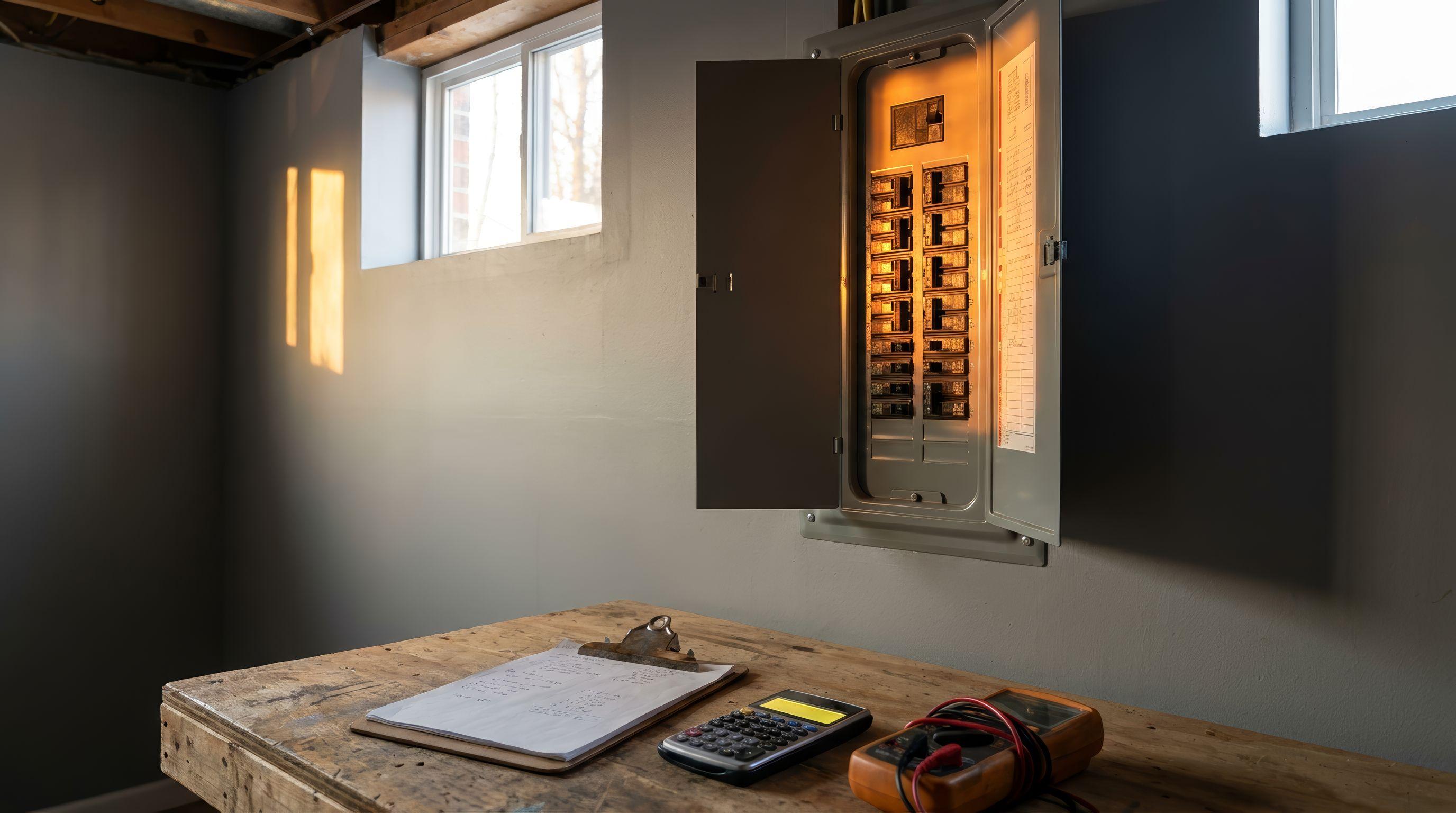
The most common question we get on the phone is some version of: how much does it cost to replace my electrical panel? It is a fair question and a hard one to answer with a single number, because the real cost depends on what is behind the panel and what your local utility requires. This guide gives realistic 2026 ranges based on jobs RCC Electric has done across the Knoxville, Maryville, Oak Ridge, Maynardville, and Farragut markets.
We will cover what a panel upgrade actually involves, what makes the price move up or down, how utility coordination differs by city, and the specific case of older Federal Pacific and Zinsco panels that have become an insurance issue.
The short version: what you should expect to pay
For most East Tennessee homes with reasonably accessible electrical, a 200A residential panel replacement runs between $2,200 and $3,800 fully installed. That figure includes the new panel and breakers, all the labor to swap it over and re-label every circuit, the permit pulled with your local jurisdiction, and the final electrical inspection.
If the service entrance, the meter base and the conductors coming from the utility, also needs work, plan on an additional $800 to $2,000. The signs that the meter base needs to go are usually obvious: rust on the outer enclosure, cracked sealant, conductors visibly weather-damaged where they enter the meter.
Federal Pacific Stab-Lok and Zinsco panel removals add roughly $200 to $400 of careful disconnect work, because those bus bars require extra attention to avoid damaging service-side wiring during removal. Mast and service drop replacement (the run from your house up to the utility's drop point) is another $400 to $1,000 if needed.
What drives the cost up or down
Six factors move panel-upgrade prices in our market. Understanding them tells you whether a quote you have received is reasonable for the work involved.
- Service entrance condition. If the meter base is older than the panel, the utility usually requires it to be replaced at the same time. Adding mast and service-drop work increases labor.
- Number of active circuits. Every existing circuit gets reconnected, labeled, and tested. A panel with 30 active circuits takes longer than a panel with 18.
- Panel brand. Square D QO and Eaton CH (premium tier) cost more than Siemens or General Electric (mid-tier), but offer longer warranties and better breaker availability for future expansion.
- Whole-home surge protection. We strongly recommend installing a Type 2 surge protector at the new panel for $150 to $300 in materials. Adds a single inspection step.
- Permit fees vary by jurisdiction. City of Knoxville, Knox County, City of Maryville, Alcoa, Oak Ridge, Anderson County, and Union County all have slightly different fees and timelines.
- Finish work. Drywall patching, paint touch-up, and access cuts in finished basements can add to the bottom line if the panel is in a finished space.
The Federal Pacific and Zinsco situation
If your home was built between 1955 and 1990 in East Tennessee, there is a real chance you have a Federal Pacific Stab-Lok panel or a Zinsco panel. Both brands have well-documented failure modes where breakers do not trip under fault conditions, allowing wiring to overheat and start fires. The Consumer Product Safety Commission has investigated both. Federal Pacific lost a class-action lawsuit in 2002. Both companies are out of business.
What changed recently for East Tennessee homeowners specifically is the insurance landscape. Tennessee homeowners insurance carriers, State Farm, Allstate, Erie, USAA, have all moved to either surcharge or refuse to write coverage on homes with these panels. We have had clients calling us specifically because their insurance company sent a letter requiring panel replacement or non-renewal.
If your home has a Federal Pacific Stab-Lok or Zinsco panel, the panel upgrade is no longer a maintenance question, it is a safety and insurance question. The two visible signs to look for: the brand name printed on the panel cover (FPE, Stab-Lok, or Zinsco), and breakers that look noticeably different from modern Square D or Eaton breakers (older, thinner handles, often with red or pink markings on Federal Pacific).
Utility coordination differs by city
Panel upgrades require coordination with whichever utility serves your address. Inside Knoxville and most of Knox County, that is Knoxville Utilities Board (KUB). KUB typically scheduling cuts the morning of the install and reconnects the same afternoon. We schedule the cut directly with KUB's contractor desk; same-day reconnects are normal.
Maryville and Alcoa are served by Alcoa Electric or the City of Maryville, depending on the specific address. Oak Ridge is served by Oak Ridge Utility District (ORUD). Powell Valley Electric covers most of Union County, including Maynardville, Sharps Chapel, and Luttrell. Plateau Electric serves parts of Anderson County. Each utility has slightly different lead times, anywhere from same-day in Knox County to two to three business days for rural cooperative utilities.
The practical impact on you: in Knoxville and Maryville, your panel upgrade is almost always a single-day job with about four to six hours without power. In rural areas served by smaller utilities, the disconnect and reconnect may need to be scheduled across two days, with overnight without power. We coordinate everything and confirm timing before quoting.
Should you upgrade to 200A even if your current panel is 100A?
In almost every case, yes. The cost difference between a 100A and a 200A panel is small, usually $300 to $500 in materials. The labor is essentially identical. And 200A service gives you the capacity headroom for an EV charger (40-60A), a hot tub (50A), mini-split HVAC (15-30A), a heat-pump water heater (30A), and any other future loads.
RCC Electric has not installed a residential 100A panel in years. Even on smaller homes, the math just does not work to save $400 and limit future capacity. The only exception is a small accessory dwelling unit or a guest cabin where the load is genuinely small and unlikely to grow.
If you are getting quotes for a panel upgrade, make sure the contractor is quoting a 200A panel by default unless you specifically need otherwise. A quote for 100A on a primary residence in 2026 is a sign the contractor is not thinking about your long-term needs.