EV adoption in East Tennessee has accelerated faster than most parts of the country, and Knoxville-area homeowners are some of our most frequent customers for Level 2 home charger installation. If you are considering a home EV charger in 2026, this guide covers the current tax credits, the real installed cost, and the four decisions worth thinking through before you buy.
We will skip the basics of why you need a Level 2 charger at home (the short answer: Level 1 on a standard 120V outlet adds 3 to 5 miles per hour and is functionally useless for daily driving). The interesting questions are what it really costs and what to buy.
The federal tax credit, and how to know if you qualify
The Alternative Fuel Vehicle Refueling Property Credit (IRS Form 8911) currently covers 30% of the cost of EV charging equipment plus installation, up to $1,000 for residential property. To qualify, the property must be located in a census tract that meets specific eligibility criteria, broadly, low-income tracts and non-urban tracts.
For our service area, the practical answer is that most of Knox County's rural and suburban tracts qualify, all of Union County qualifies, most of Anderson County qualifies, and significant portions of Blount, Campbell, Claiborne, and Grainger counties qualify. The IRS provides an online address-lookup tool, search "IRS 8911 eligibility map" and enter your address to confirm.
In dollar terms: for a typical $1,500 install (charger plus labor and permit), the federal credit returns $450 at tax time. If your install includes a panel upgrade and totals $4,000, the credit caps at $1,000 (the maximum for residential property). Combined with utility incentives below, the effective out-of-pocket cost is often 25 to 35% less than the headline price.
Utility incentives, KUB, ORUD, Powell Valley, and the rest
As of early 2026, KUB (Knoxville Utilities Board) does not offer a direct rebate for Level 2 home charger installations, but they do offer reduced electricity rates for off-peak EV charging through the Time-of-Use rate program. The savings for an EV household charging exclusively during off-peak hours can be $300 to $500 per year compared to standard residential rates.
Powell Valley Electric (serving Union County including Maynardville and Sharps Chapel) and Oak Ridge Utility District (ORUD) have similar time-of-use programs. Alcoa Electric and the City of Maryville do not currently offer EV-specific rates but have signaled they are studying them for 2026 and 2027.
The practical impact: if you commute mostly during the workweek and can plug in at home overnight (most EV drivers), enrolling in your utility's time-of-use rate plan after installing a charger is essentially free money. We can recommend smart Wi-Fi chargers that automatically charge during off-peak windows.
What a Knoxville EV charger install actually costs in 2026
The price of a home EV charger install depends on three factors: the charger itself, your existing panel capacity, and the run distance from the panel to the charger mounting location.
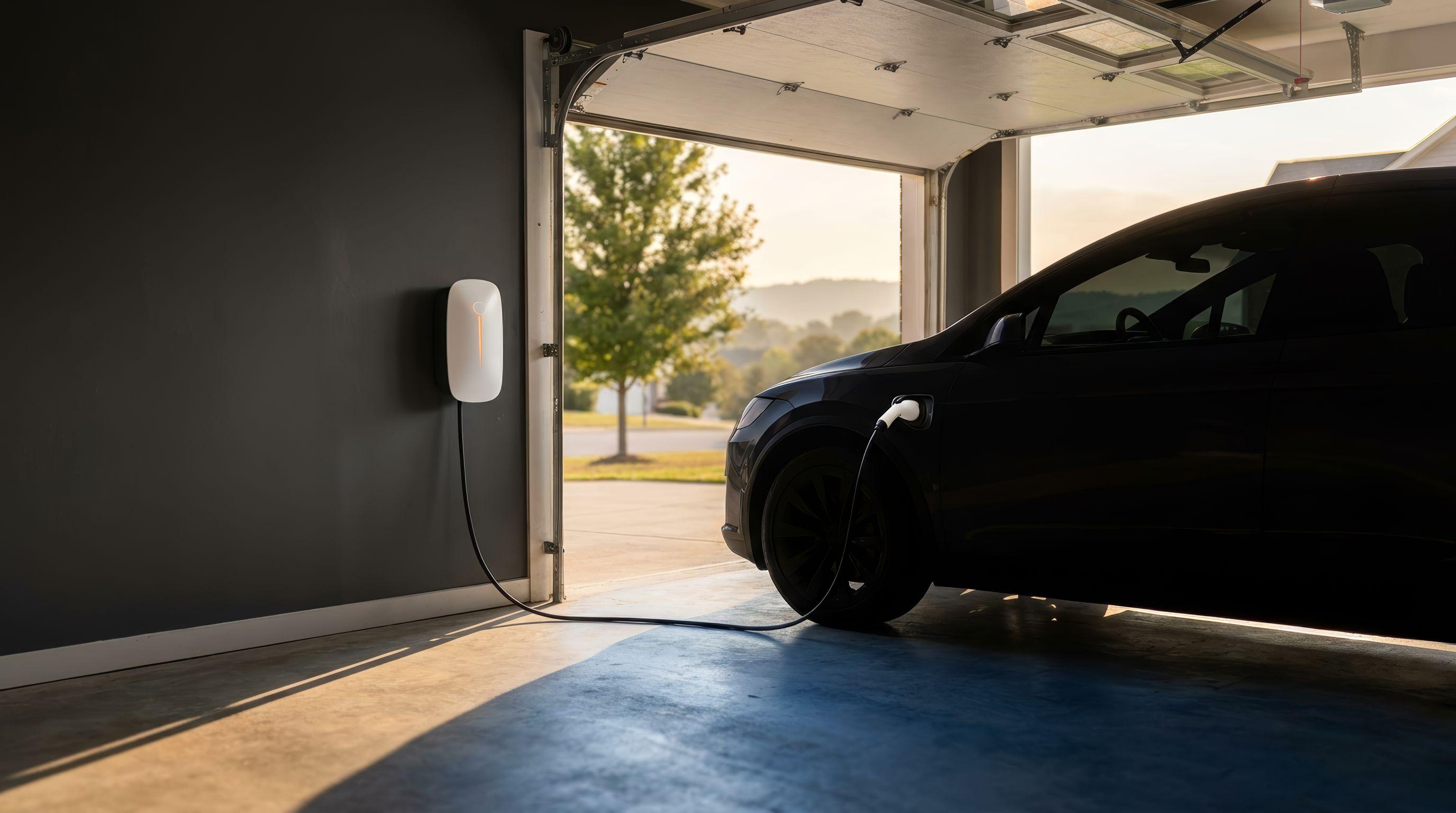
Charger cost: a Tesla Wall Connector Gen 3 runs about $475 retail. A ChargePoint Home Flex is around $700. A JuiceBox 48 is around $700. A Wallbox Pulsar Plus is $650. Most major-brand 48A Level 2 chargers fall between $500 and $750. Tesla Wall Connectors work with non-Tesla vehicles via included J1772 adapter, which has made them popular even outside the Tesla owner community.
Installation labor for a typical Knoxville-area install runs $500 to $1,200, depending on conduit run length, whether the run is in a finished or unfinished space, and any panel work required. Most residential installs in Knox County come in around $750 to $900. Outlying counties may add modest travel labor but it is not significant.
Panel work, if needed: most 200A panels installed in homes built after 2000 have room for a Level 2 charger circuit without modification. If your panel is full (no open spaces), a load calculation determines whether tandem breakers can free up space, or whether a panel upgrade is needed. A full 100A to 200A panel upgrade runs $2,500 to $4,000, see our separate panel upgrade cost guide for details.
Total realistic budget. For most Knoxville-area homeowners with a 200A panel and a typical attached garage install, expect $1,200 to $1,800 all-in (charger plus install plus permit) before the federal tax credit. After the 30% federal credit, net cost is closer to $850 to $1,260.
The four questions worth asking before you buy a charger
First: 40A or 48A charger? A 48A charger needs a 60A circuit and gives faster charging. A 40A charger on a 50A circuit charges plenty fast for nearly all overnight charging needs and costs less to install. Unless you drive a high-mileage daily commute or have two EVs sharing the charger, 40A is the right answer for most households.
Second: hardwired or plug-in? A NEMA 14-50 plug install is slightly less expensive and lets you take the charger with you if you move. A hardwired install is more permanent, capable of higher amperage, and considered slightly safer over the long term. Both are code-compliant. We default to hardwired for new installs unless the homeowner specifically wants portability.
Third: smart features? Wi-Fi-enabled chargers cost about $100 more and let you schedule charging, track energy use, and use utility off-peak rates automatically. For most households, the smart features pay for themselves in under a year through off-peak charging savings.
Fourth: indoor or outdoor mounting? Most home installs go in a garage. If you do not have a garage, common in older Maryville and downtown Knoxville bungalows, all major brands have outdoor-rated models. The install is similar, you just specify the outdoor-rated variant when ordering.