Backyard living is a big deal in East Tennessee. Between the milder winters than the Midwest, the long shoulder seasons, and the lake-and-mountain culture, more homeowners than ever are adding hot tubs, pool heaters, outdoor kitchens, and ambient backyard lighting. All of those involve electrical work, and outdoor electrical has more code requirements than most homeowners realize.
This guide covers what is involved in wiring the four most common East Tennessee backyard projects: hot tubs, pool heaters, outdoor kitchens, and landscape lighting. We will hit code requirements, real-world costs, and the questions worth asking before a contractor starts pouring concrete.
Hot tub wiring, what you need before delivery day
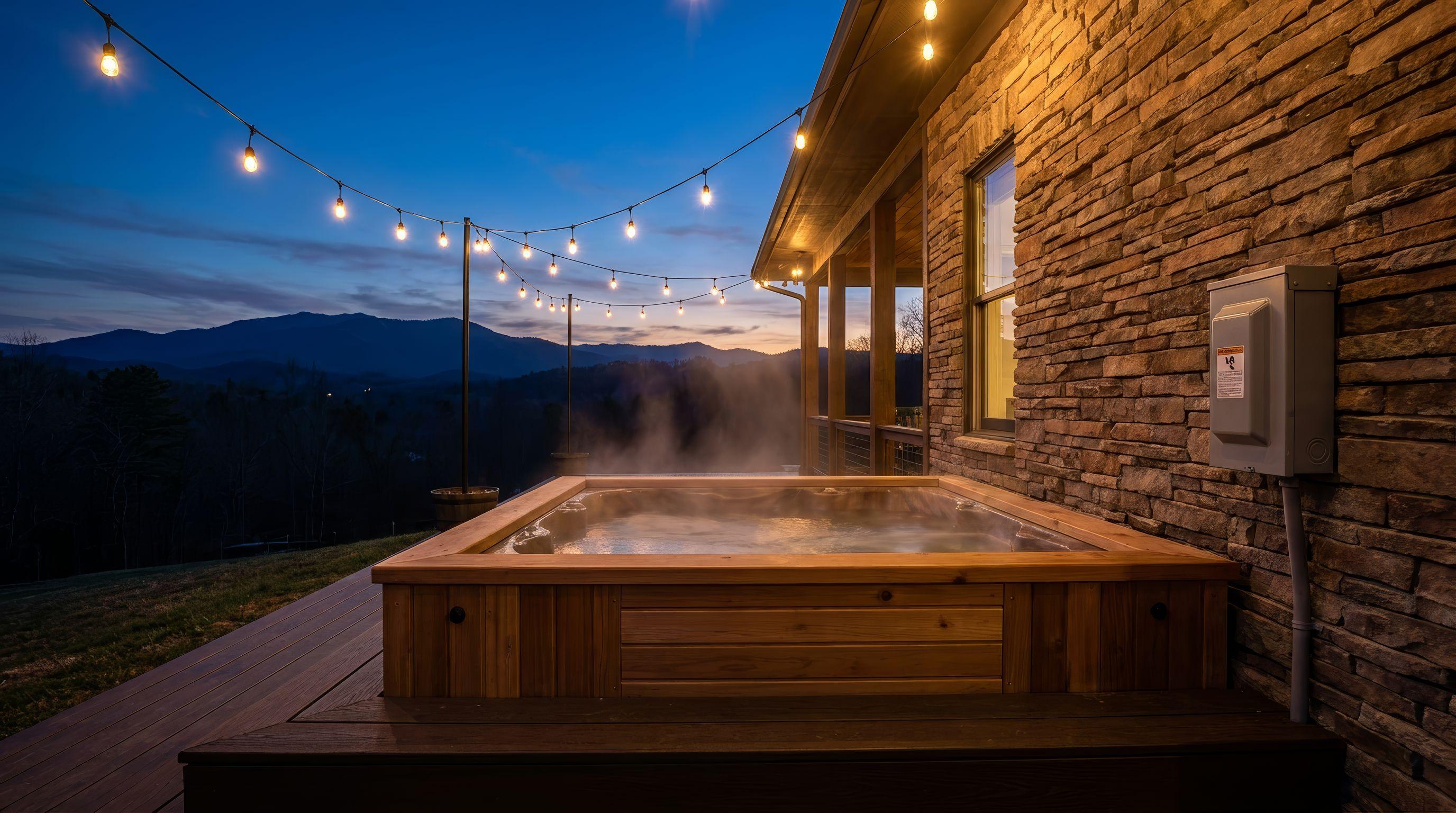
A modern 240V hot tub needs a dedicated 50A or 60A GFCI-protected circuit, plus an outdoor disconnect mounted within sight of the tub but at least 5 feet away from the water. The disconnect is critical: anyone in the tub during an emergency needs to be able to reach a non-electrified switch without leaving the water near anything electrical.
The most common mistake we see on East Tennessee hot tub installs is having the tub delivered and dropped onto its pad before the electrical work is done. That backs the homeowner into a corner: the tub is in place, the manufacturer wants it filled and running, and the electrician is being rushed. Have the electrical roughed in before delivery day. We can run the conduit, install the disconnect, and pull the wire in advance so it is ready when the tub arrives.
Cost expectations: a typical East Tennessee hot tub wiring job runs $800 to $2,200. The range reflects how far the new circuit needs to run from the panel to the tub location, whether the run is in finished basement / crawl space (more labor) or through unfinished space (less), and whether a panel upgrade is needed to free up the capacity for the new circuit.
Pool heater and pool equipment electrical
Pool electrical falls under NEC Article 680, which is its own dedicated code section with stricter rules than ordinary outdoor wiring. Bonding requirements alone are a project, every metallic part of a pool installation (the pool shell rebar, the heater, the pump, the lighting, the diving board ladders) must be bonded together with a common bonding grid that connects back to the electrical system.
For East Tennessee homeowners adding pool electrical, we typically wire: a 240V circuit to the pool heater (gas heaters still need a 120V control circuit; electric heat pumps need a 240V dedicated circuit at 30-60A), a 240V circuit to the variable-speed pump on its own GFCI-protected circuit, the bonding grid that ties everything together, and the underwater lighting on a low-voltage transformer circuit.
Cost expectations: pool electrical for a new in-ground pool typically runs $2,500 to $6,500 depending on the equipment and the bonding requirements. Above-ground pools are simpler, usually $800 to $1,800 for the pump and heater circuits, plus bonding.
Many East Tennessee pool builders subcontract the electrical separately. When you are getting bids for a pool, ask explicitly whether the electrical is included or separate, and what the electrical scope is. We have done plenty of fix-it work on pools where the original electrical was undersized or missing bonding because the pool builder assumed the homeowner would handle it.
Outdoor kitchens, fire features, and outdoor TVs
Outdoor kitchens are a growing category in East Tennessee, especially around lake homes on Norris and Cherokee. A typical outdoor kitchen needs at minimum: a 20A GFCI circuit for a refrigerator, a separate 20A circuit for the cooktop or grill rotisserie (if electric), GFCI outlets for small appliances, and lighting. More elaborate setups add a dedicated circuit for an outdoor TV, dimmable ambient lighting on its own circuit, and sometimes a dedicated heater circuit.
All of this needs to be in weatherproof outdoor enclosures. Outlets must be in "while-in-use" covers, the bubble-style covers that protect the plug even when something is plugged in. Every receptacle outside must be GFCI-protected at the device or at a feed-through receptacle upstream.
Outdoor fire features (fire pits with electric ignition, gas log lighters with electric controls) need a 120V circuit run to the control location with weatherproof boxes and GFCI protection. Fire feature electrical is usually less than $400 in materials and labor, but skipping the proper enclosures is a code violation and a fire risk.
Outdoor TVs need a dedicated circuit (the TV pulls real wattage) plus either a hardwired hookup or an outdoor-rated receptacle behind the mount. The TV itself should be outdoor-rated; standard indoor TVs degrade quickly in East Tennessee's humidity and freeze-thaw cycles. Plan on $300 to $700 for the electrical portion of an outdoor TV install.
Landscape lighting and ambient backyard wiring
Landscape lighting in East Tennessee almost always runs on low-voltage 12V or 24V circuits through a transformer that takes 120V from a GFCI outlet on the home's exterior. Low-voltage runs are safer (cannot deliver a fatal shock through a cut wire), easier to work with (no conduit required for buried runs), and lets you add fixtures over time without code complications.
What you need from an electrician on a landscape lighting project: the GFCI outlet on the exterior wall, a properly sized transformer mounted on the wall near the outlet (sized to handle the planned wattage plus 20% headroom for future expansion), and the initial low-voltage circuit out from the transformer if you want the heavy-load main feeder run professionally. From there, homeowners can extend the system themselves with low-voltage cable and add fixtures as desired.
Cost expectations for the electrical portion: $400 to $900 for the GFCI outlet, transformer, and main feeder. The fixtures themselves are typically a separate landscaping or DIY purchase.
East Tennessee climate considerations
East Tennessee's freeze-thaw cycles and high summer humidity destroy non-rated outdoor electrical equipment fast. We see standard indoor-rated outlets installed outside that turn to dust within three or four winters. Pools and hot tubs especially have a way of finding any weakness in an electrical install: moisture, chlorine, salt-water systems, and constant temperature swings all stress materials.
What this means practically: do not let any contractor, pool builder, landscaper, deck builder, install electrical with non-rated indoor materials and tell you it will be fine. Outdoor electrical specifically rated for wet locations is a small price premium and lasts decades. Indoor-rated equipment used outdoors lasts a season or two and creates real shock hazards as it ages.
When in doubt, ask the contractor whether the specific outlets, boxes, conduit, and fittings they are using are listed for wet locations. The answer should always be yes for anything outdoors in our climate.